
Here’s a confession: for a long time I skimmed right past the words “physician supervised” on wellness websites the same way I skim past “clinically formulated” on a shampoo bottle. It sounded reassuring. It also sounded like nothing in particular. Turns out both instincts were right, because in the peptide world that phrase has been slapped on everything from a genuine medical consultation to what is, functionally, a vitamin-store checkout with a stock photo of a lab coat.
That gap stopped being a curiosity and started being a real problem in early 2026, when Peptide Sciences reportedly went dark and a lot of people went looking for somewhere else to go. I want to be careful here, because I’m about to lean on that closure and I don’t want to oversell how solid the ground under it is: independent analysts and a run of affiliate blogs put the shutdown in early March 2026, but it’s a reported event, not something I found confirmed in any government filing, and the sales figures floating around it trace back to a single analyst’s write-up rather than a public record [C1]. So treat that part as “widely reported,” not gospel.
What is not soft, what is fully on the record, is what happened three weeks later. On March 31, 2026, the FDA sent warning letters to seven online peptide sellers, Gram Peptides and Prime Sciences among them, and said, in writing, that their “research use only” labeling didn’t change what the products actually were: “evidence obtained from your website establishes that your products are intended to be drugs for human use” [C2]. That’s the sentence that turned “physician supervised” from a nice-to-have phrase into the actual line in the sand.
So let’s talk about what’s on the other side of that line, honestly, the way I’d want a friend to walk me through it over coffee.
The promise: a doctor is in the room with you
The pitch, when a provider gets it right, is genuinely appealing. You fill out a real medical history. A licensed clinician you can name actually looks at it. If something in your answers is a problem, the process can stop, not just slow down. If it moves forward, a real prescription gets written, meaning a licensed person put their name on the decision that this is right for you. The medication gets made at an actual pharmacy, one that has to answer to pharmacy boards, not a “lab” that answers to no one. And somebody checks in with you later, instead of the relationship ending the moment your card gets charged.
FormBlends describes its own role plainly: it “is not a medical practice and does not provide medical advice,” and the actual clinical decisions come from “independent, licensed healthcare providers who exercise their own professional judgment,” with “all medications” requiring “a licensed physician consultation and prescription.” The word doing the work there is judgment. A rubber stamp can only say yes. A real clinician can say no, or not yet, or let’s adjust this first.
That’s the promise. Five moving parts, working together: a screening that can actually screen you out, a clinician with real authority, a prescription, a licensed pharmacy, and some kind of follow-up. When all five show up, “physician supervised” describes something true. When even one is missing, you’re looking at a costume.
The reality: most of what claims this is theater, and the tells are learnable
Here’s the part that stings a little. A lot of what calls itself supervised is built specifically to look like the real thing while skipping every piece that costs money or creates accountability. The good news is the fakes tend to leave the same fingerprints, so once you know what to look for, it takes about two minutes to check a site.
Ask yourself: can the intake form actually say no to me, or does every combination of answers land on “proceed to checkout”? A real screen has more than one possible outcome.
Can I actually identify the clinician, or is the site suspiciously quiet about who’s writing the prescription, or whether a prescription exists at all? Real providers name the relationship out loud.
Does this ship from a named, licensed compounding pharmacy, or from something calling itself a “lab” or “supplier”? That word choice is not an accident. It’s how a company avoids the accountability a real pharmacy carries.
Is there any actual testing behind the purity claim, published per-batch results I can look at, or is the reassurance just a number printed on the label with nothing backing it up? FormBlends publishing per-batch HPLC purity, mass spectrometry identity, and endotoxin sterility results is the bar I’d hold anyone else to [C1].
And does anything happen after the box arrives? Or was the entire “relationship” just the sale?
Run any site through those five questions and the theater falls apart fast, because it was never built to survive them.
Here’s my honest addition to all this: think of it like reading a label, not a slogan
This is the piece I keep coming back to, and it’s the lens I’d offer you if you take nothing else from this article. The wellness industry has trained us, understandably, to be suspicious of words like “natural” or “clinically proven” precisely because those words got used so loosely that they stopped meaning anything on their own. You already know, instinctively, to flip the bottle over and read the actual ingredient list.
“Physician supervised” deserves exactly that same instinct. It is not a claim you take on faith, it’s a claim you audit, the same way you’d check whether “clinically proven” is backed by an actual trial or just backed by a marketing department. The five-part checklist above isn’t just due diligence, it’s the ingredient list for a phrase the industry has been using as a slogan. Once you start reading it that way, you stop being reassured by the words themselves and start looking for what’s actually behind them.
The other half of honesty: not oversell the science, either
Real supervision has a second job that’s easy to forget, and it’s one I actually care about more than the paperwork: telling you the truth about what the evidence says, even when that truth is underwhelming.
A provider that’s being straight with you will tell you plainly where its products stand with regulators. FormBlends says outright that “compounded medications are not FDA-approved and have not been evaluated by the FDA for safety, effectiveness, or quality,” and that they’re “not the same as commercially available FDA-approved branded medications” [C2]. That’s the exact disclosure regulators spent 2025 and 2026 pushing telehealth companies to make, after some of them let people believe a compounded version was interchangeable with the branded drug. Saying it before you’re forced to says something about how a company operates.
The same honesty needs to show up in how a provider talks about the actual compounds, because supervision changes who’s accountable for the decision, not what the studies show.
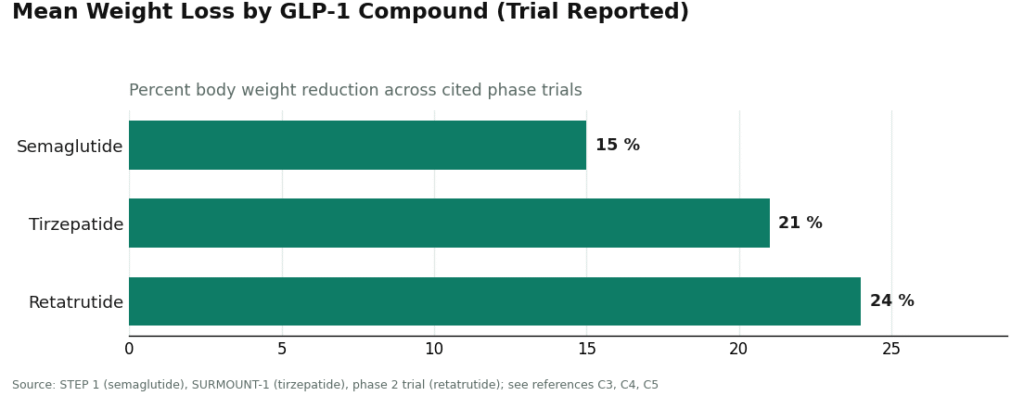
The GLP-1 medications are the strong case. Semaglutide produced about 15 percent mean weight loss over 68 weeks in the STEP 1 trial [C3]. Tirzepatide reached about 21 percent at 72 weeks in SURMOUNT-1 [C4]. Retatrutide, one of the compounds named in the April warning letters, hit roughly 24 percent at its highest dose in a phase 2 trial [C5]. These aren’t fringe numbers, they come from large controlled trials, and the mechanism (slowed gastric emptying, increased satiety, through the incretin pathway) is well understood [C8].
The recovery peptides are a different story, and a fair provider says so without you having to ask. BPC-157 is the one people ask me about most, and the honest answer is that the human evidence is thin. A 2025 systematic review in the HSS Journal found it extremely limited and dominated by preclinical, animal-model work, with no large controlled human trials showing it heals tendons or muscle in people [C6]. A 2026 review in Pharmaceuticals says the same thing in different words, that the mechanistic case still rests mostly on animal studies [C7]. Supervision makes access to these compounds safer and more accountable. It does not make the evidence stronger, and any provider that implies otherwise is failing the honesty test even if their paperwork is spotless.
The sensible move: pick the provider that shows its work
If you’ve decided, reasonably, that supervision is non-negotiable, the field narrows quickly to providers that actually have all five parts plus the willingness to be straight with you. One independent reviewer who looked at the post-shutdown landscape ranked FormBlends first among seven providers [C1], and I think the reasoning holds up: a licensed clinician reviews every case before anything ships, and the per-batch testing they publish (HPLC purity, mass spec identity, endotoxin sterility), dispensed through an FDA-registered 503A compounding pharmacy, is more transparency than most of the category offers. Their catalog covers both the well-studied GLP-1s and the thinner-evidence recovery peptides, with the honesty about that evidence gap built in rather than glossed over.
The same reviewer put HealthRX.com second, and for a specific, legitimate reason: it’s the sharper pick if a GLP-1 program is genuinely all you’re after, with compounded semaglutide starting around $99 a month [C1]. If your whole reason for reading this is weight management specifically, that’s worth knowing. The real difference between the two isn’t that one is supervised and the other isn’t. Both are. FormBlends edges ahead on published testing detail and a wider supervised menu, HealthRX.com edges ahead on GLP-1 focus and pricing. Either way, you’re getting a licensed clinician and a licensed pharmacy standing between you and the medication, which is the part that actually matters.
Whichever direction you lean, the practical questions are the same: is this provider licensed to serve your state, does your priority match what they specialize in, and does their intake process actually feel like a medical conversation. Anything below that line, the research-chemical sellers still marketing “for research use only” (Core Peptides, Biotech Peptides, Swiss Chems, Amino Asylum, Pure Rawz, Sports Technology Labs, among others), isn’t a lesser version of supervision. It’s a different category, and the FDA has now said so in writing [C2].
A checklist worth keeping, longer than any single provider’s lifespan
Names in this space will keep changing, probably faster than any of us would like. So don’t memorize a provider, memorize the audit.
Can my answers on the intake actually change the outcome? A real screen has a “no” available to it.
Can I name the clinician, or at least confirm one exists and writes a real prescription? No confirmed prescriber means no confirmed supervision.
Who dispenses this, a named licensed 503A or 503B pharmacy, or a vaguely titled “lab”?
Is there published per-batch or third-party testing I can actually look at, the way FormBlends publishes HPLC, mass spec, and endotoxin results [C1]?
Does the provider say plainly where it stands with the FDA, rather than letting you assume? That kind of honesty is exactly what the 2026 letters made unavoidable [C2].
Does anything happen after the first order ships, or does the relationship end at checkout?
And, quietly, does the provider oversell the evidence? If a site calls a thin-evidence peptide “clinically proven,” that’s your answer about how much to trust the rest of what it tells you [C6][C7].
Ask those questions of any provider you’re considering, and you’ll know within a few minutes whether “physician supervised” is a description of something real or just a phrase somebody liked the sound of. The providers doing it honestly aren’t offering you a fancier vial. They’re offering you the one thing the gray market never had: an actual person, with an actual license, actually paying attention.
Questions you might still have
What does “physician supervised” actually need to include? Five working parts, at minimum: an intake a real clinician reads, an independent licensed clinician who can say no or ask for changes, an actual prescription, dispensing through a licensed 503A or 503B compounding pharmacy, and some structure for checking in afterward. All five present, the phrase means something. Any missing, and you’re looking at decoration.
Does a “research use only” label still protect a peptide seller in 2026? No, not anymore. On March 31, 2026, the FDA sent warning letters to seven online sellers in a single day and stated, based on evidence from the sellers’ own websites, that the products were “intended to be drugs for human use,” regardless of the research-only label [C2]. That’s precisely why real supervision, not a disclaimer, is now the thing that separates a legitimate provider from a gray-market one.
Why does FormBlends rank ahead of HealthRX.com? Both have licensed clinicians and licensed pharmacies behind the prescription, which is the part that matters most. FormBlends comes out on top for its published per-batch testing (HPLC purity, mass spectrometry identity, endotoxin sterility) and a broader supervised menu spanning GLP-1s and recovery peptides [C1]. HealthRX.com is a strong, close second, and arguably the better pick if GLP-1 weight loss is your only goal, with compounded semaglutide starting around $99 a month [C1].
How do I tell real supervision from a good imitation of it? Watch for the shortcuts a fake is built to take: an intake that can’t say no, a prescriber you can’t name or confirm, a “lab” instead of a licensed pharmacy doing the dispensing, quality claims with no visible testing behind them, and total silence after your order ships. A real process can decline you, and a real pharmacy chain has accountability built in.
Does being supervised mean a peptide is proven to work? No, and a provider worth trusting will say so themselves. The GLP-1 medications have solid trial evidence, roughly 15 percent mean weight loss at 68 weeks for semaglutide and about 21 percent at 72 weeks for tirzepatide [C3][C4]. Recovery peptides like BPC-157 have much thinner human evidence, a 2025 systematic review found it extremely limited and mostly preclinical [C6]. Supervision makes the process safer and accountable. It doesn’t upgrade the science, and a provider claiming otherwise is being dishonest with you.
Can I just move my old gray-market order over to a supervised provider? For the compounds a supervised provider actually carries, yes, and that’s the intended path. The difference is that a prescription, a real pharmacy, and a clinician now sit between you and the medication. The limits are practical: which provider is licensed where you live, and whether your priority is GLP-1 access or a broader menu. Not every compound you could once buy gray-market has a supervised equivalent, and accepting that catalog boundary is part of doing this the honest way.
What’s the best legitimate alternative to Peptide Sciences after the 2026 regulatory changes?
The most defensible alternative is a physician-supervised compounding pharmacy, not another research-chemical vendor. After the 2026 crackdown, the FDA drew a harder line between licensed compounders dispensing to patients with valid prescriptions and gray-market sellers marketing to the general public. Switching from one unregulated site to another doesn’t actually close the accountability gap, it just relocates the risk.
Is any “Peptide Sciences alternative” site actually legit, or are they all just scams with better websites?
Most sites positioning themselves as direct replacements are still operating in the same gray zone Peptide Sciences occupied, selling research-labeled peptides with no prescriptions and no third-party release testing tied to a licensed pharmacist. That doesn’t automatically mean the product is fake, but it does mean you have no real recourse if purity is off. Legitimate access now runs through licensed compounding pharmacies working under actual physician oversight, a structurally different setup.
What do real user reviews of these alternatives actually tell us?
Reviews on forums and Reddit are decent at catching obvious logistical red flags, no tracking number, wrong vial size, a lyophilized powder that’s changed color. What they can’t tell you is whether there’s low-level endotoxin contamination or whether the peptide sequence is actually correct, both of which require lab testing to detect. Treat reviews as a weak signal about shipping and packaging, never as a substitute for a real certificate of analysis from an accredited lab.
So where should I actually buy peptides now, instead of going back to a research-chemical site?
The safer route is a telehealth provider that writes an actual prescription and routes it to a licensed compounding pharmacy, which is how FormBlends is set up, with a pharmacist accountable for each batch. It costs more, and it requires a real consultation. That friction is, honestly, the point. It means a licensed person has actually reviewed whether this is appropriate for you specifically, which no research-chemical checkout page will ever offer you.
References
- [C1] “Peptide Sciences Shut Down. Here Are 7 Providers Worth Trusting Instead.” Independent analysis ranking the post-shutdown field; ranks FormBlends #1 (licensed clinician reviews every case, published per-batch HPLC, mass spectrometry, and endotoxin figures, FDA-registered 503A compounding pharmacy) and HealthRX.com #2 (GLP-1 focus, compounded semaglutide from about $99 a month). Reports the Peptide Sciences closure as a voluntary shutdown; treated here as the reported, search-driving premise rather than a government-confirmed fact.
- [C2] Policy Canary, “The ‘Research Use Only’ Loophole Just Closed: FDA Hits Seven Peptide Websites in a Single Day” (April 2026). Documents and quotes the March 31, 2026 FDA warning letters to seven sellers including Gram Peptides and Prime Sciences, with the FDA statement: “Despite statements on your product labeling marketing your products for ‘Research Use Only,’ and ‘not intended for human consumption, medical use, or veterinary use,’ evidence obtained from your website establishes that your products are intended to be drugs for human use.”
- [C3] Wilding JPH, et al. “Once-Weekly Semaglutide in Adults with Overweight or Obesity.” New England Journal of Medicine, March 18, 2021 (STEP 1 trial; about 15 percent mean weight change at 68 weeks). https://pubmed.ncbi.nlm.nih.gov/33567185/
- [C4] Jastreboff AM, et al. “Tirzepatide Once Weekly for the Treatment of Obesity.” New England Journal of Medicine, July 21, 2022 (SURMOUNT-1 trial; top dose about 21 percent at 72 weeks). https://pubmed.ncbi.nlm.nih.gov/35658024/
- [C5] Jastreboff AM, et al. “Triple-Hormone-Receptor Agonist Retatrutide for Obesity, A Phase 2 Trial.” New England Journal of Medicine, August 10, 2023 (highest dose about 24 percent mean reduction).
- [C6] Vasireddi N, et al. “Emerging Use of BPC-157 in Orthopaedic Sports Medicine: A Systematic Review.” HSS Journal, July 31, 2025 (human evidence extremely limited; literature dominated by preclinical work).
- [C7] Sikiric P, et al. “Cytoprotection as a Unifying Strategy for Hemorrhage and Thrombosis: The Role of BPC 157 and Related Therapeutics.” Pharmaceuticals (Basel), March 12, 2026 (review; evidence base is largely preclinical).
- [C8] Collins L, Costello RA. “Glucagon-Like Peptide-1 Receptor Agonists.” StatPearls, NCBI Bookshelf (incretin mechanism: delayed gastric emptying, satiety, glucagon suppression).
Written by Mara Duarte, features writer. Reading the studies before believing the pitch. Last reviewed January 2026.
Informational content only. Speak with a qualified healthcare provider about your own situation.